
What is this black rock?
Black rocks are some of the hardest to identify from looks alone: dozens of different rocks and minerals are black. A few quick tests sort them out fast.
Black comes from iron, magnesium, carbon or manganese, and plenty of minerals have those. So rather than guessing from color, use four quick tests. You only need a magnet, the back of a white tile and your eyes.
The four quick tests
- Magnet: does it stick strongly, weakly or not at all? (See why is my rock magnetic?)
- Streak: rub it on an unglazed tile. Black, red-brown, brown or none? Use the streak test identifier.
- Shine: glassy like a bottle, metallic like steel, or dull?
- Weight: does it feel normal or heavy for its size? Measure with the specific gravity calculator.
12 common black rocks and minerals
| Rock | Shine | Magnet | Streak | Other clues |
|---|---|---|---|---|
| Basalt | Dull | None to weak | Grey-white (rock powder) | Fine-grained, may have small holes; very common |
| Obsidian | Glassy | No | White, or scratches tile | Sharp curved breaks, smoky edges, volcanic areas |
| Magnetite | Metallic to dull | Strong | Black | Heavy; black beach sand |
| Hematite | Metallic or dull | None to very weak | Red-brown | Heavy; sometimes sparkly ("specular") |
| Slag | Glassy patches | Often | Varies | Bubbles, flow marks, near tracks and roads (slag vs meteorite) |
| Coal | Dull to shiny | No | Black | Very light, soft, leaves black dust on fingers |
| Jet | Waxy, polishes well | No | Brown | Very light, warm to touch; fossil wood |
| Black chert / flint | Waxy | No | None (hard) | Hard, smooth curved breaks, in chalk or limestone |
| Black tourmaline (schorl) | Glassy | No | White, or none | Long crystals with lengthwise grooves, often in granite |
| Gabbro / diabase | Dull, speckled | Weak | Grey | Coarser grains than basalt; often sold as "black granite" |
| Black shale / slate | Dull | No | Grey-black | Splits in thin layers; may hold fossils |
| Meteorite | Dull, thin crust | Usually | None or faint brown | Heavy, no bubbles, metal flecks inside (rare) |
Narrow it down fast
- Strongly magnetic + heavy + black streak: magnetite.
- Heavy + red-brown streak: hematite.
- Glassy + curved sharp breaks: obsidian (or man-made glass).
- Bubbles + glassy bits + magnetic: slag.
- Very light + leaves black dust: coal.
- Long grooved crystals: black tourmaline.
- Dull, fine-grained, common: basalt.
- Heavy + magnetic + thin crust + no bubbles: check our meteorite checker.
Where you found it matters
Where a black rock comes from narrows the list a lot before you do a single test:
| Where you found it | Most likely black rocks |
|---|---|
| Volcanic area (Hawaii, Oregon, Iceland, Canary Islands) | Basalt, obsidian, scoria |
| Beach or river gravel | Basalt, black chert, shale, slate |
| Near old factories, railways or roads | Slag, coal, clinker |
| Farm fields and deserts | Basalt, desert-varnished rocks, occasionally a meteorite |
| Mines and mine dumps | Magnetite, hematite, tourmaline, galena |
| Chalk cliffs and limestone areas | Flint nodules |
Check the inside, not just the outside
Many rocks are only black on the outside. Desert varnish, river staining and weathering crusts can make light rocks look black. If you're allowed to, chip a small corner off (wear eye protection) or look at an existing break:
- Black all the way through: basalt, obsidian, coal, magnetite or black chert are likely.
- Grey or light inside: probably a weathered or coated rock, often limestone, sandstone or granite.
- Shiny metal inside with a thin black skin: possible meteorite or slag. Do the magnet and bubble checks.
Common mix-ups
- Obsidian vs black glass slag: slag often has round bubbles, swirls of color and rusty bits. Obsidian is uniform with sharp, curved breaks.
- Coal vs jet: both are light and burn. Jet is hard enough to take a polish and leaves a brown streak. Coal is dull or sooty and dirties your fingers.
- Hematite vs magnetite: both are heavy. Hematite has a red-brown streak and is barely magnetic. Magnetite has a black streak and grabs a magnet.
- Black tourmaline vs hornblende: tourmaline crystals are long with lengthwise grooves and a rounded-triangle cross-section. Hornblende has two clear cleavage planes.
Are black rocks valuable?
Most black rocks are common. Nice black tourmaline crystals, specular hematite and rainbow or sheen obsidian sell as specimens for a few dollars to more. Real meteorites and good jet can be worth much more. See is my rock valuable?, or snap a photo with RockFinder to find out what yours is.
Questions people ask
What is the most common black rock?
Basalt. It's a dark volcanic rock that makes up the ocean floor, Hawaii, Iceland and huge lava plains. It's dull black to dark grey, fine-grained, often with small holes, and can be weakly magnetic.
How do I tell obsidian from black glass?
Both are glass, so they look alike. Obsidian often has a slightly smoky look at thin edges, faint flow bands, and sometimes tiny white or silvery inclusions. Man-made glass is usually perfectly uniform and may contain round bubbles. Where you found it helps: obsidian occurs in volcanic areas.
Is a black shiny rock valuable?
Usually not. Most black shiny rocks are obsidian, hematite, slag or black tourmaline, which are common. Black diamonds, fine jet and some meteorites are valuable, but rare. Identify it first.
What black rock is attracted to a magnet?
Magnetite is strongly magnetic. Slag with iron in it and most meteorites are magnetic too. Basalt and gabbro can be weakly magnetic. Hematite is usually not noticeably magnetic.
Keep reading
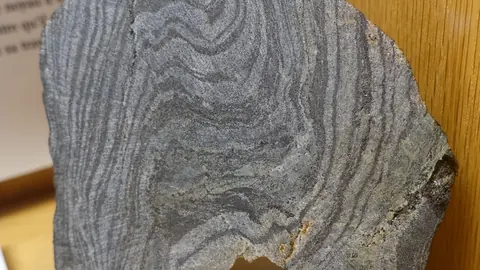
Why is my rock magnetic?
Magnetite, slag or a meteorite? What makes a rock stick to a magnet.
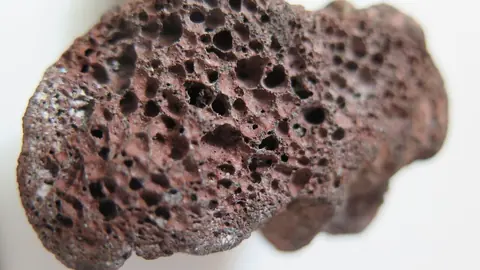
Slag vs meteorite: how to tell them apart
Bubbles, glass and flow marks vs fusion crust and metal: the quick tests.
Magnetite: the rock that grabs your magnet
The mineral that made the first compass, and fools meteorite hunters daily.