
How to tell if a gold nugget is real
Real gold nuggets sell for well above the gold price, so fakes turn up online, at markets and in 'grandpa's old collection'. Most give themselves away in a few minutes with things you already own.
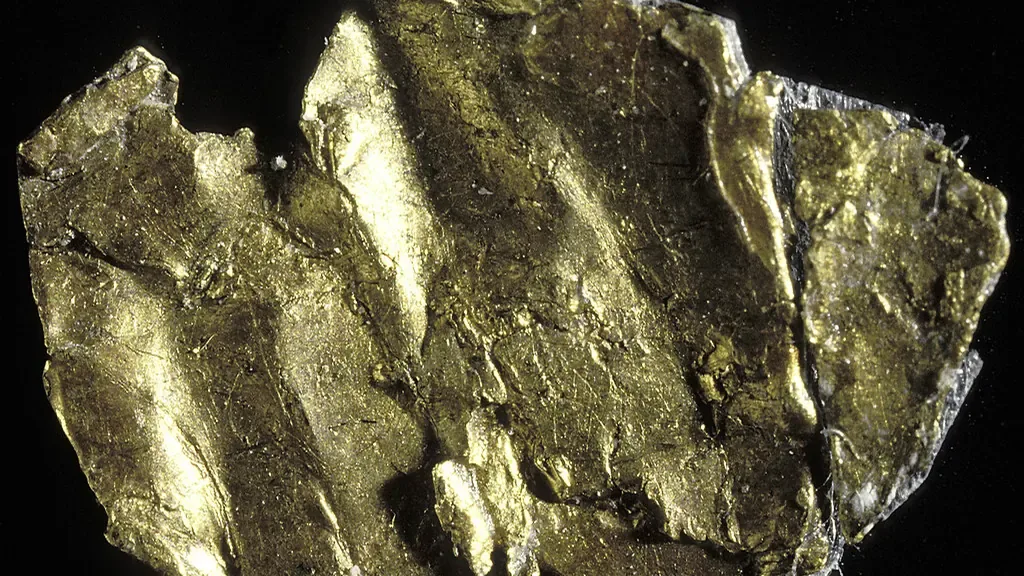
If you think your nugget might be real, don't scrape, file or melt it. Natural nuggets are often worth more than their weight in gold to collectors. The tests below are all non-destructive or only touch a tiny hidden spot. If you found something shiny and aren't sure it's even gold-colored metal, start with our gold vs fool's gold guide.
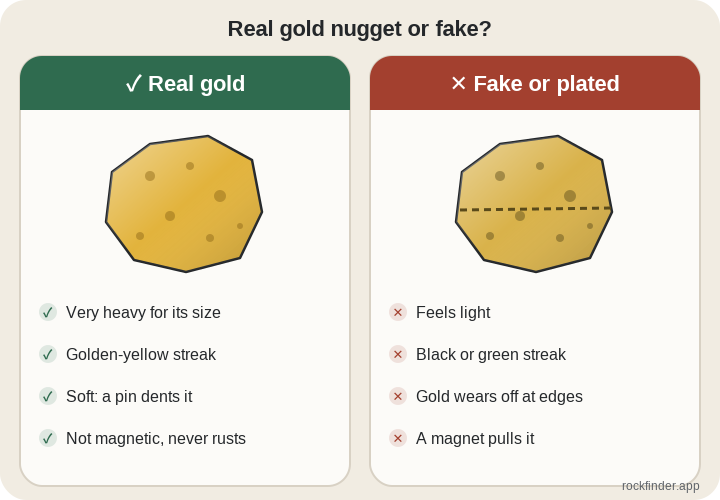
6 safe tests for a gold nugget
1. The weight (density) test: the best one
Gold is one of the heaviest things you'll ever hold. Pure gold has a specific gravity of 19.3, and natural nuggets, which contain some silver, usually measure about 15 to 19. Brass is about 8.5, lead 11.3, pyrite 5. Weigh the nugget, then weigh it hanging in water, and enter both numbers in our specific gravity calculator. Small nuggets need a scale that reads to 0.01 g.
The one fake that can match gold's weight is gold-plated tungsten. It's rare in nuggets but common in fake bars; a dealer's electronic tester catches it.
2. The streak test
Rub a hidden corner gently across the unglazed back of a white tile. Gold leaves a golden-yellow streak. Pyrite leaves greenish-black, brass leaves dark grey to black, and lead leaves grey. Only a tiny mark is needed.
3. The magnet test
Gold isn't magnetic. If a strong fridge or neodymium magnet grabs it, it isn't solid gold. A small pull can also come from black sand stuck in the nugget's cracks, so look closely at where the pull is.
4. The pin test
Gold is soft: about 2.5 to 3 on the Mohs scale. A steel pin pressed into a hidden spot dents it like soft lead. Pyrite is too hard to dent; brass resists more. Keep the dent tiny.
5. The color and shade test
Turn the nugget slowly under a lamp, then shade it with your hand. Real gold stays the same warm, buttery yellow from every angle and never tarnishes, rusts or turns green. Brass often has a slightly greenish or pinkish tone and darkens over time; copper shows red.
6. The wear and shape test
Look closely at high points and edges with a magnifier. On plated fakes, the gold wears thin and a grey, silver or reddish metal shows through. Real nuggets are gold all the way through. Natural nuggets are also rounded, pitted and often have bits of quartz or iron stain in the hollows; cast fakes may show casting seams, tiny round bubbles or repeated identical shapes across a "lot".
Common fake "nuggets"
| Fake | Weight | Streak | Other giveaway |
|---|---|---|---|
| Brass casting | Light (SG ~8.5) | Dark grey to black | Darkens, slightly green tint |
| Gold-plated lead | Medium (SG ~11) | Grey | Very soft, grey shows at wear points |
| Painted rock | Light | Rock-colored | Paint chips, flat dull shine |
| Pyrite | Light (SG ~5) | Greenish black | Hard, brittle, sharp cubes |
| Gold-plated tungsten | Very heavy | Grey under plating | Needs a dealer's tester |
What a real nugget is worth
Nuggets are priced by weight, but usually above the plain gold value, because collectors pay for natural shapes. Small, plain nuggets may sell close to their melt value; attractive, crystalline or "specimen" nuggets with quartz can fetch much more. Get a rough figure from our gold nugget value calculator, then have it checked by a reputable assayer or coin dealer before you sell.
Still not sure?
Snap a photo with RockFinder to see whether your find looks like gold, pyrite, chalcopyrite or mica, and get a safe test to confirm it.
Questions people ask
How can I test if gold is real at home?
Weigh it and work out its density with a kitchen scale and a cup of water: real gold is about 15 to 19 times as heavy as the same volume of water, far more than any fake. Then do a streak test on the back of a white tile (gold leaves a golden-yellow line) and check it with a magnet (gold isn't magnetic).
Does real gold stick to a magnet?
No. Gold isn't magnetic. If a strong magnet pulls the nugget, there's iron or nickel inside. But passing the magnet test doesn't prove it's gold, because brass, copper and lead aren't magnetic either.
Do fake gold nuggets exist?
Yes. Common fakes are brass or bronze castings, lead or tungsten coated with gold, gold-painted rocks, and pyrite or chalcopyrite sold as gold. Real nuggets are also sometimes 'enhanced' by melting gold scraps into nugget shapes.
Is it safe to do the acid test at home?
We don't recommend it. Gold test acids are strong nitric and hydrochloric acids that burn skin and give off fumes. A jeweler, coin dealer or assayer can test it safely, often for free or a small fee.
Keep reading
Gold or fool's gold? How to tell real gold from pyrite
Five quick tests to tell real gold from pyrite, and what each is worth.
How to find gold in creeks and rivers
Where gold settles in a creek and how to pan it out, step by step.
Is my rock valuable? How to tell if a rock is worth money
What makes a rock worth something, and how to check before you sell.