
How to tell if a rock is quartz
Quartz is the most common mineral you'll pick up, and it comes in every color. It's also easy to confuse with calcite, feldspar and glass. These six tests sort it out with things you have at home.
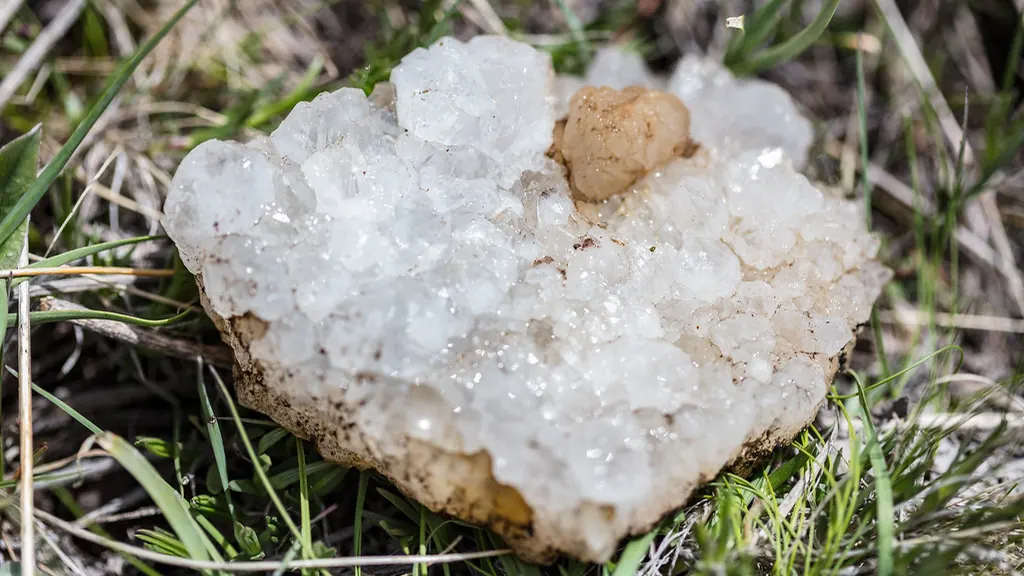
Quartz makes up a big share of the sand on beaches and the pebbles in rivers. It's in granite, sandstone and countless veins. So when you find a white, clear or glassy rock, quartz is the best first guess. Here's how to confirm it.
Test 1: Does it scratch glass?
Quartz has a hardness of 7, harder than glass (about 5.5) and steel (about 5.5). Press a sharp corner of your rock firmly across a glass bottle or old jar and check for a real scratch (rub it; powder wipes off, scratches don't). Quartz scratches glass easily. If a steel knife scratches your rock, it isn't quartz. Our hardness test helper walks you through it.
Test 2: The shine
Fresh quartz surfaces look glassy, like broken glass. Weathered pebbles may look frosted, but a fresh break shows the glassy shine again. Fine-grained quartz like chert and agate looks waxy instead.
Test 3: How it breaks
Quartz has no cleavage: it doesn't split along flat planes. Broken quartz shows curved, shell-like surfaces called conchoidal fracture, the same as broken glass. Minerals with flat, shiny, step-like broken faces are probably feldspar or calcite.
Test 4: Crystal shape
If your quartz has crystals, they're six-sided columns ending in a six-sided point, often with fine horizontal lines across the sides. No other common mineral looks quite like this.
Test 5: The vinegar test
Put a drop of vinegar on the rock. Quartz does nothing. If it fizzes, it's calcite (or limestone or marble).
Test 6: Weight and streak
Quartz has a specific gravity of about 2.65, the same as most ordinary rock, so it shouldn't feel unusually heavy. Its streak is white, but because it's harder than a streak plate it usually just scratches the tile. Check with the specific gravity calculator if you're unsure.
Quartz vs look-alikes
| Mineral | Hardness | Vinegar | Breaks | Other clues |
|---|---|---|---|---|
| Quartz | 7, scratches glass | No fizz | Curved, glassy | Six-sided pointed crystals |
| Calcite | 3, coin or knife scratches it | Fizzes | Flat, slanted box shapes | Clear calcite shows double images |
| Feldspar | 6, scratches glass with effort | No fizz | Flat, shiny steps | Often pink, white or grey; blocky |
| Glass | 5.5 | No fizz | Curved, glassy | Bubbles, swirls, too perfect |
| Selenite (gypsum) | 2, fingernail scratches it | No fizz | Splits into thin flexible sheets | Feels warm, soft |
| Halite | 2.5 | No fizz | Cubes | Tastes salty, dissolves in water |
The many kinds of quartz
- Rock crystal: clear, colorless
- Milky quartz: white, the common vein quartz (see rocks with white lines)
- Amethyst: purple, often in geodes
- Citrine: yellow to orange (much "citrine" in shops is heated amethyst)
- Smoky quartz: brown to black
- Rose quartz: pink, usually without crystal faces
- Microcrystalline quartz: chalcedony, agate, jasper and chert
- Quartzite: a rock made of quartz grains fused together (see quartzite)
Is my quartz worth anything?
Plain white quartz pebbles are worth nothing in money, but clear, sharp, undamaged crystals and clusters sell for a few dollars to a lot more, depending on size and quality. Amethyst and smoky quartz clusters are popular. Look out for gold in quartz, a classic collector specimen. Read Is my rock valuable? for more.
Where quartz hides in other rocks
Quartz is the second most common mineral in Earth's crust, so you'll find it inside many other rocks:
- Granite: the grey, glassy grains between the pink or white feldspar and black specks
- Sandstone: most of the sand grains are quartz
- Quartzite: almost pure quartz grains welded together
- White veins cutting through dark rocks
- Geodes: lined with quartz or amethyst crystals
- Beach sand: often mostly quartz grains
Is it quartz, glass or a gem?
Clear quartz is often confused with glass and with more valuable clear gems. A few clues help:
- Glass often contains round bubbles, feels warmer, and is softer (it doesn't scratch other glass easily).
- Quartz feels cold, may have tiny cracks or wispy inclusions, and scratches glass.
- Topaz and diamond are harder than quartz and much rarer. A clear crystal you found in a creek is far more likely to be quartz. See how to tell if a diamond is real.
For more on telling natural crystals from glass, read glass vs crystal.
Questions people ask
How can I tell quartz from glass?
Quartz is harder: it scratches glass easily, while glass only scratches with effort against other glass. Glass often has round bubbles and swirl lines inside and feels warmer to the touch. Natural quartz often has tiny cracks, cloudy patches or inclusions, and is never perfectly uniform like glass.
What is the difference between quartz and calcite?
Calcite is much softer (a knife or coin scratches it), fizzes with a drop of vinegar, and breaks into slanted, box-like pieces with flat faces. Quartz scratches glass, doesn't fizz, and breaks with curved surfaces.
Is quartz valuable?
Common white quartz is worth very little. Nice clear crystals, clusters and colored varieties like amethyst, citrine and smoky quartz are worth more, from a few dollars to hundreds for large or very fine specimens. Quartz with gold in it can be valuable.
What colors does quartz come in?
Clear (rock crystal), white (milky quartz), purple (amethyst), yellow to orange (citrine), brown-black (smoky quartz) and pink (rose quartz). Fine-grained quartz forms agate, chalcedony, jasper and chert in almost any color.
Keep reading
Quartzite: the toughest rock on the beach
Sandstone, baked until it's nearly indestructible. Here's how to spot it.
Chalcedony: the glowing stone hiding on beaches and riverbanks
Hold it up to the sun and it glows. The beach stone with a hundred names.
What is a rock with white lines through it?
White veins, bands or a full white ring: what they are and how to tell.