
What is a rock with white lines through it?
Dark stones crossed by bright white lines are some of the most picked-up rocks on any beach or trail. The lines tell a story: the rock cracked long ago, and something white grew in the gap.
A dark pebble with a bright white stripe, or a white line that wraps all the way around: these are some of the most common "what is this?" rocks. In almost every case the answer is one of three things.
1. Quartz veins (the most common)
Long ago, the rock cracked. Hot water full of dissolved silica flowed through the crack and slowly deposited quartz, sealing it up. Quartz is often milky white, so it stands out sharply against dark basalt, greywacke, slate or granite.
- The white line is hard: it scratches glass and a knife won't scratch it
- It looks glassy or milky, sometimes with tiny crystals
- It often stands up slightly from the surface, because quartz wears away slower than the rock around it
- No reaction to vinegar
Learn more: how to tell if a rock is quartz.
2. Calcite veins
In limestone, marble and many other rocks, the veins are calcite instead. They look similar but behave differently:
- Soft: a knife scratches calcite easily (hardness 3)
- Fizzes with a drop of vinegar or lemon juice (try a scratched spot)
- Often sits slightly lower than the surface, because it dissolves and wears faster
- Sometimes breaks into shiny, slanted flat faces
3. Banding in metamorphic rock
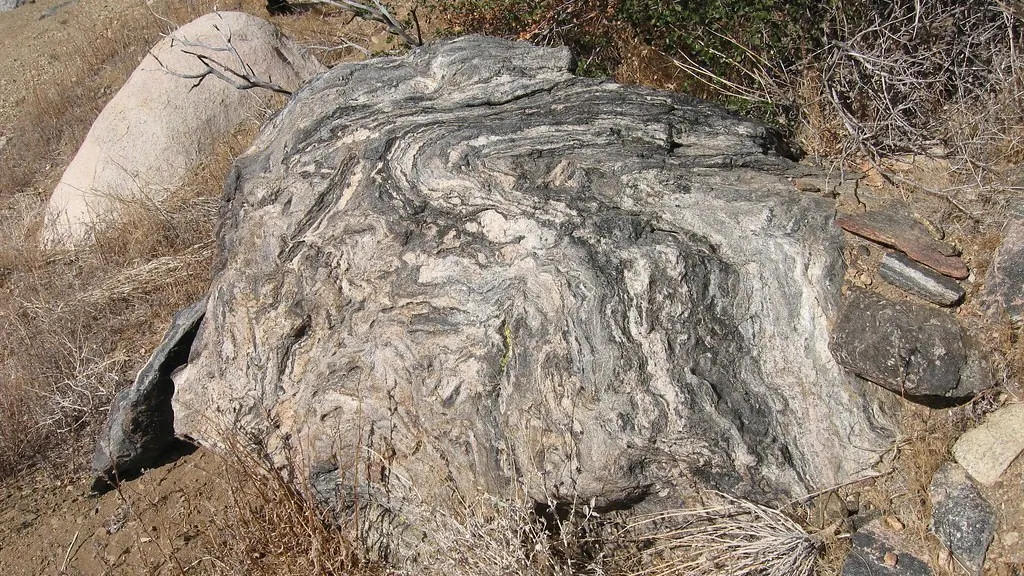
If the white isn't a single line but many parallel stripes, often wavy or folded, you may have gneiss or a similar metamorphic rock. Under heat and pressure deep underground, light minerals (quartz and feldspar) and dark minerals (mica, hornblende) separate into bands. Unlike a vein, the bands are part of the rock's own texture, and they usually follow each other in the same direction.
Vein or band? A quick comparison
| Vein | Banding | |
|---|---|---|
| Number of lines | One or a few, can cross each other | Many, roughly parallel |
| Edges | Sharp, like a filled crack | Blurred, grading into each other |
| Mineral | Quartz or calcite | Quartz + feldspar (light) and mica or hornblende (dark) |
| Rock | Any rock | Gneiss, migmatite, some schist |
Wishing stones
A stone with an unbroken white ring all the way around it is called a "wishing stone" by beachcombers, especially on the beaches of New England, Canada and the UK. The ring is just a vein running right through the pebble, cut neatly by the waves. Tradition says you make a wish and throw it back into the sea. It's free, it's fun, and it's one of the nicest things you can find on a beach.
Other white lines
- Fossils: thin white lines that curve or branch may be shells, crinoid stems or coral. See how to tell if a rock is a fossil.
- Layers: thin, flat, parallel lines in sandstone or shale are original sediment layers.
- Agate bands: curved, translucent bands that glow with a flashlight. See our agate guide.
How white veins form
Rocks crack when they're squeezed, bent or cooled. Water moving through the cracks carries dissolved minerals, and when conditions change (the water cools, pressure drops or the chemistry shifts) the minerals come out of solution and seal the crack. Quartz and calcite are the most common vein minerals because they dissolve easily in hot water and are both white. A rock with several sets of crossing veins records several separate cracking events, and geologists use the order the veins cut each other to work out the rock's history.
Test it in two minutes
- Scratch the white line with a steel nail. Quartz won't scratch. Calcite scratches easily.
- Put a drop of vinegar on it. Calcite fizzes. Quartz doesn't.
- Check if the line goes all the way around. A vein that circles the whole stone is what makes a traditional "wishing stone".
- Look at the edges. Sharp, straight edges mean a vein. Wavy, blurred edges and repeated layers mean banding in a metamorphic rock like gneiss.
Gold in white veins?
Quartz veins are where much of the world's gold was found, so prospectors pay close attention to them. But the vast majority of quartz veins have no visible gold. Real gold looks like soft, bright yellow specks or threads that don't change shine when you tilt the rock. Brassy cubes are pyrite. See our gold vs pyrite guide.
Is it valuable?
Most veined rocks are common and worth little, though they make beautiful polished stones. The exception: gold in quartz. Gold forms in some quartz veins, and specimens of gold in white quartz are valued by collectors. If you see bright yellow metal in the quartz, check it isn't pyrite with our gold vs pyrite guide.
Questions people ask
What is a rock with a white ring around it called?
Beachcombers call a stone with an unbroken white line all the way around it a 'wishing stone' or 'wishing rock'. Geologically, the ring is a quartz or calcite vein that filled a crack running through the stone. Folklore says you make a wish and throw it back into the sea.
Are white lines in rocks quartz?
Very often, yes. Quartz veins are the most common kind. Test it: quartz is hard enough to scratch glass and doesn't react to vinegar. If the white line is soft enough to scratch with a knife and fizzes in vinegar, it's calcite.
Is a rock with quartz veins valuable?
Usually not; quartz veins are very common. But gold is sometimes found in quartz veins, which is why prospectors follow them. If you see bright yellow metal in the white quartz that's soft and doesn't crumble, it's worth a closer look.
Why do rocks have veins?
When rocks are squeezed, bent or cooled, they crack. Hot, mineral-rich water flows through the cracks and slowly deposits minerals like quartz and calcite, sealing the crack with a new, usually lighter-colored mineral. That's a vein.
Keep reading
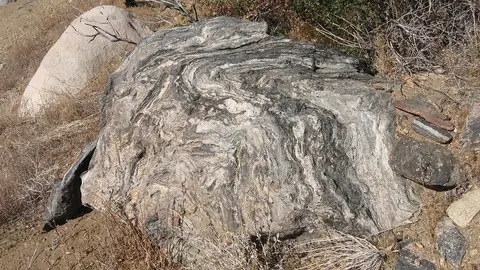
Gneiss: the striped rock that's been to the depths of the Earth
Pronounced 'nice'. Striped, folded, and sometimes 4 billion years old.
Quartzite: the toughest rock on the beach
Sandstone, baked until it's nearly indestructible. Here's how to spot it.
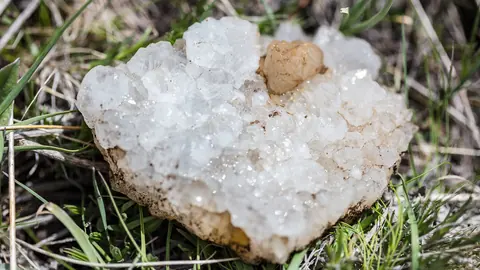
How to tell if a rock is quartz
Six easy tests to tell quartz from calcite, glass and feldspar.