
How to tell if a diamond is real
Cubic zirconia, moissanite and even glass can pass for a diamond at a glance. A few safe tests at home will catch most fakes; for anything valuable, a jeweler's tester settles it in seconds.
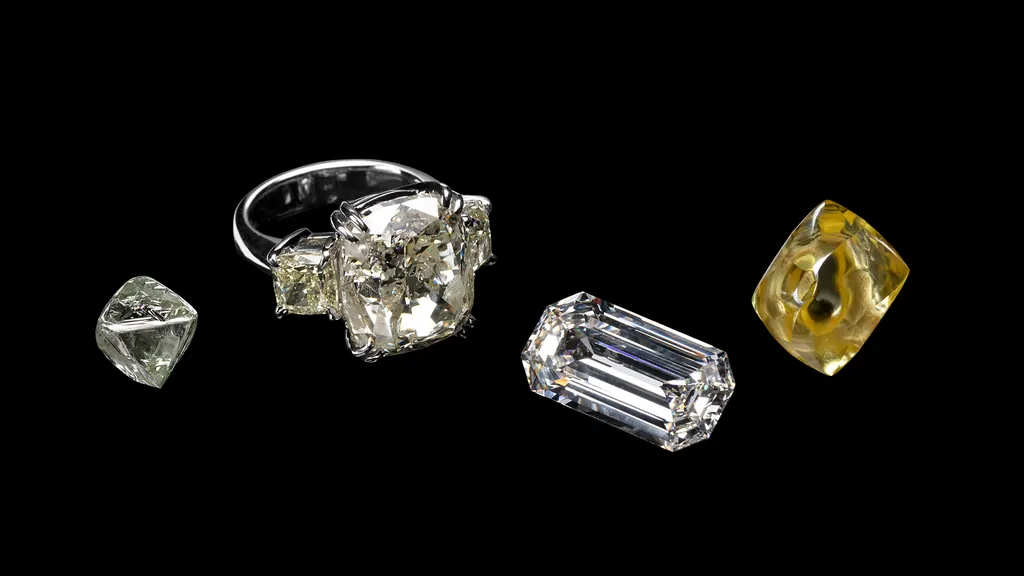
First, some good news: if the stone came from a reputable jeweler with a lab report (GIA, IGI or similar), it's almost certainly what the paper says. These tests are for inherited rings, market finds, online buys and "is this real?" moments. None of them will harm a real diamond.
6 safe tests at home
1. The fog test
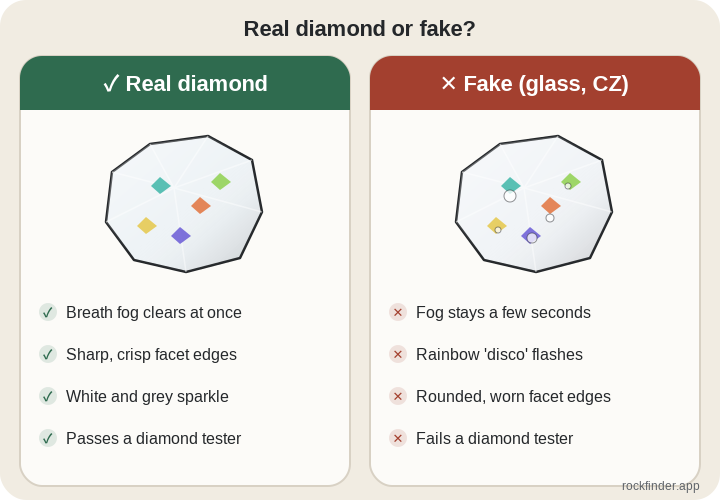
Clean the stone, then breathe on it like you're fogging a mirror. Diamond spreads heat very fast, so the fog disappears almost instantly. On cubic zirconia and glass it lingers for 2 to 5 seconds. Compare with a stone you know is fake if you can. (Moissanite also clears fast, so this test doesn't catch it.)
2. The sparkle test
Under a single light, a diamond throws a mix of bright white and grey flashes with some color. Cubic zirconia is famous for a "disco ball" effect: lots of rainbow flashes. Moissanite shows even more rainbow fire, especially in sunlight.
3. The read-through test (loose stones only)
Place a loose round stone upside down (point up) on a line of newspaper print. A well-cut diamond bends light so strongly that you usually can't read the letters or see a clear line through it. With glass and many CZs you can see the print or a dark ring. Fancy shapes and poorly cut diamonds don't always pass, so use this as a clue only.
4. The edge test
Look at the facet edges with a 10x loupe or your phone's zoom. Diamond is the hardest natural material, so its edges stay razor sharp even after decades of wear. Glass and old CZ get rounded, scuffed and chipped edges, and scratches on the flat top facet.
5. The setting and stamp test
Real diamonds are usually set in gold or platinum. Look inside the band for stamps like 10K, 14K, 18K, 585, 750, PT or PLAT. A "C.Z." stamp means cubic zirconia. Cheap metal that's turning green or worn to a different color is a hint the stone isn't valuable either (though it's not proof).
6. The diamond tester
Handheld testers cost about $15 to $30 online, and jewelers test for free. A basic thermal tester separates diamond from CZ and glass. Moissanite fools it, so use a multi-tester that also checks electrical conductivity if moissanite is a possibility.
Tests we don't recommend
- Scratching glass or a mirror: many fakes scratch glass too, and you can chip the stone.
- The fire or heat-and-water test: heating then dropping a stone in cold water can crack fakes, but also stresses settings and stones with inclusions. Not worth the risk.
- The "water sink" test: most gemstones and fakes sink too, so it proves nothing.
Diamond or imitation?
| Stone | Fog clears | Sparkle | Thermal tester |
|---|---|---|---|
| Diamond (mined or lab) | Instantly | White and grey, some color | Diamond |
| Moissanite | Fast | Strong rainbow fire | Reads as diamond (needs multi-tester) |
| Cubic zirconia | 2 to 5 seconds | Lots of rainbow | Not diamond |
| White sapphire | A few seconds | Weaker sparkle | Not diamond |
| Glass | Slow | Dull, worn edges | Not diamond |
Found a rough "diamond"?
Rough diamonds look nothing like cut ones: they're frosted or greasy-looking, often yellowish, and shaped like rounded eight-sided crystals. Most clear pebbles people find are quartz. Try our gemstone identification guide or the quartz tests first.
Still not sure?
For a ring or loose stone, a jeweler's free test is the quickest answer. For a rough crystal you found, snap a photo with RockFinder to see what it most likely is.
Questions people ask
How can I tell if a diamond is real at home?
Breathe on it like a mirror: a real diamond clears almost instantly, while cubic zirconia and glass stay fogged for 2 to 5 seconds. Then look at the sparkle (real diamonds flash mostly white and grey with some color, CZ flashes lots of rainbow) and check the facet edges with a magnifier for wear.
Does a real diamond scratch glass?
Yes, but so do many fakes: cubic zirconia, moissanite, sapphire and quartz all scratch glass too. So the scratch test can't prove a diamond is real, and it can chip a stone. We don't recommend it.
Is moissanite a fake diamond?
Moissanite is a different, real gemstone (silicon carbide) that looks very similar to diamond and is almost as hard. It isn't a diamond, and it fools basic heat testers. A moissanite-capable tester or a jeweler can tell them apart.
Are lab-grown diamonds real diamonds?
Yes. Lab-grown diamonds are chemically and physically real diamonds, made in a factory instead of underground. Home tests and basic testers can't tell them apart from mined diamonds; a gem lab can. They cost much less, so they should be sold as lab-grown.
Keep reading
Gemstone identification: 7 tests you can do at home
Sapphire or blue glass? Seven at-home tests that catch most fakes.
Real or fake? How to tell if your crystals are real
7 safe home tests to spot glass, dyed and plastic fakes, plus a guide for every popular stone.
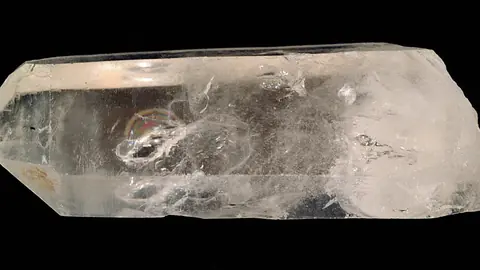
Glass vs crystal: how to tell real quartz from glass
5 quick tests to tell real quartz crystal from glass.
More guides
- Agate: how to identify it and what it's worth
- How to identify rocks: a simple step-by-step guide
- Common rocks and minerals you're likely to find
- Is my rock valuable? How to tell if a rock is worth money
- Limestone vs marble: how to tell them apart
- Types of rocks: the 3 kinds, and how to tell which one you're holding