
Gneiss: the striped rock that's been to the depths of the Earth
Gneiss (pronounced 'nice') is what happens when a rock gets cooked and squeezed so hard its minerals separate into stripes. Some gneiss is over 4 billion years old.
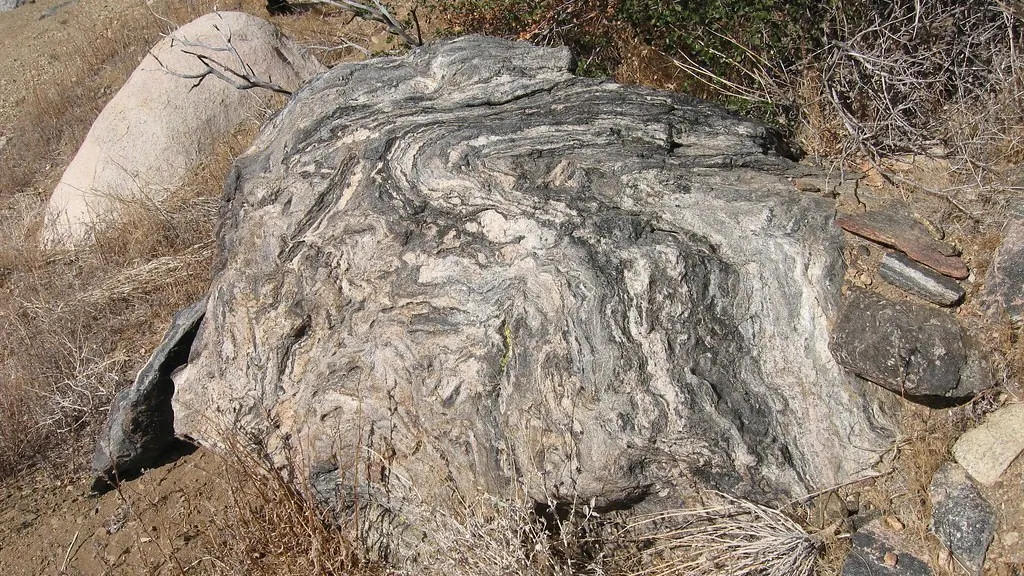
First, the pronunciation: gneiss is said "nice." Geologists have been making the same joke for 200 years ("That's a gneiss rock!") and they're not stopping now.
Gneiss is one of the most dramatic rocks you can find. Its bold black-and-white stripes swirl and fold like marble cake, recording a journey deep into the Earth's crust, to depths of many kilometers and temperatures of several hundred degrees, and back up again.
How gneiss forms
Start with granite, sandstone or shale. Push it deep under a growing mountain range, where it's hot and the pressure is crushing. The rock doesn't melt, but its minerals start to migrate: light minerals (quartz and feldspar) gather into pale bands, dark minerals (mica, hornblende) into dark bands. That striping is called gneissic banding.
It's the last step in a sequence: shale → slate → schist → gneiss. Push even further and the rock starts to melt.
How to identify gneiss
- Bands of light and dark minerals, from millimeters to centimeters wide
- Often wavy or folded, sometimes in wild swirls
- Coarse-grained: you can see individual crystals
- Hard and heavy: about 6 to 7, scratches glass
- Doesn't split into sheets, unlike schist and slate
- Sometimes has red garnets scattered through it
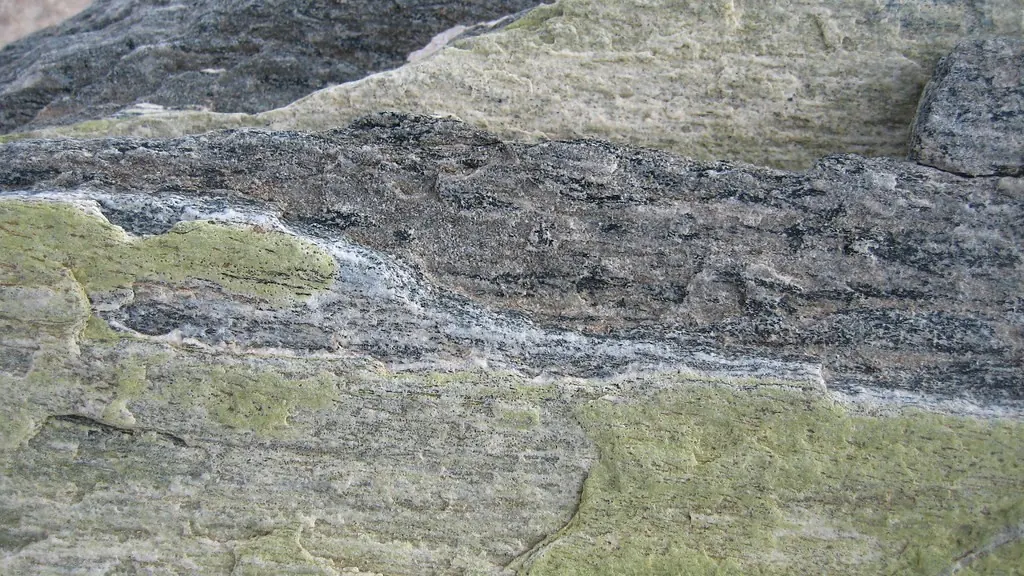
Gneiss vs look-alikes
| Rock | How it differs |
|---|---|
| Granite | Speckled evenly, no bands |
| Schist | Glittery with mica, splits into flaky layers |
| Banded sedimentary rock | Soft layers with grains; no interlocking crystals |
| Migmatite | Gneiss that partly melted: swirls of granite-like veins |
The oldest rocks on Earth
The Acasta Gneiss in northern Canada is about 4 billion years old, among the oldest known rocks on the planet. The Earth itself is about 4.5 billion years old, so this rock formed when the planet was a toddler. Similar ancient gneisses are found in Greenland and Australia.
So if you pick up a gneiss pebble, there's a decent chance it's older than most other rocks around it, sometimes by billions of years.
Where to find it
Gneiss forms in the roots of mountain ranges. You'll find it where old mountains have eroded down: Scandinavia, Scotland, the Canadian Shield, the Appalachians, the Alps and the Himalayas. Glaciers have also spread gneiss boulders across northern Europe and North America.
What's gneiss worth?
| Item | Rough value |
|---|---|
| Gneiss rocks and pebbles | Essentially nothing |
| Landscaping boulders | Sold by the ton |
| Polished gneiss slabs and countertops | Roughly $50 to $150 per square foot installed (often sold as "granite") |
| Gneiss with good garnet crystals | About $10 to $100 as a specimen |
Fun fact: many "granite" countertops are actually gneiss. The stone trade calls almost any hard, crystalline rock "granite."
Prices are rough guides.
Types of gneiss
- Banded gneiss: the classic look, with clear light and dark stripes
- Augen gneiss: big eye-shaped feldspar crystals (augen is German for "eyes") with bands wrapping around them
- Granite gneiss (orthogneiss): started out as granite or another igneous rock; looks like granite that's been stretched into streaks
- Paragneiss: started out as sandstone or mudstone; often has more mica and sometimes garnets
- Migmatite: gneiss that got so hot it partly melted, leaving swirly, marbled light and dark patches
What is gneiss used for?
- Countertops and floor tiles. Polished gneiss is often sold under the trade name "granite". Stone with wavy, flowing stripes is usually gneiss.
- Building and paving stone, because it's hard and weathers well
- Crushed stone and gravel for roads and concrete
- Landscaping boulders and garden walls, where the stripes show off nicely
Striped rock?
Snap a photo with RockFinder to see if it's gneiss, schist, granite or something else.
Questions people ask
How do you identify gneiss?
Gneiss is a hard, coarse-grained rock with alternating light and dark bands, often wavy or folded. The light bands are mostly quartz and feldspar, the dark bands mostly biotite mica or hornblende. It doesn't split into thin sheets like slate or schist.
How do you pronounce gneiss?
It's pronounced 'nice', exactly like the word. The 'g' is silent. Geologists love the pun: 'Have a gneiss day.'
What is the difference between gneiss and granite?
Granite has an even, speckled look with minerals scattered randomly. Gneiss has the same kinds of minerals, but sorted into stripes or bands from heat and pressure. Gneiss is often metamorphosed granite.
Is gneiss valuable?
Gneiss is mostly used as building stone, countertops and landscaping rock, sold by the ton or square foot. Pretty banded pebbles have small decorative value. Gneiss can host gems like garnet.
Is gneiss igneous, sedimentary or metamorphic?
Metamorphic. Gneiss forms when an older rock, like granite, sandstone or mudstone, is buried deep and changed by strong heat and pressure, which sorts its minerals into light and dark bands.
What is gneiss used for?
Countertops and tiles (often sold as "granite"), building and paving stone, crushed stone for roads and concrete, and landscaping boulders.
Keep reading
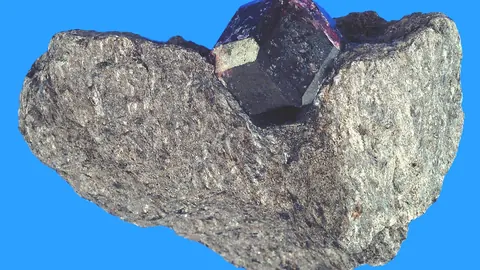
Schist: the glittery rock that hides garnets
Glitter rock with garnet raisins. And yes, the name is fun to say.
Types of rocks: the 3 kinds, and how to tell which one you're holding
Fire, layers or pressure? Every rock you find is one of three types.
Quartzite: the toughest rock on the beach
Sandstone, baked until it's nearly indestructible. Here's how to spot it.