
How to tell if turquoise is real
Turquoise may be the most faked stone in the world. Dyed howlite, dyed magnesite, plastic and resin all wear its famous sky-blue color. A few quick checks tell you which one you're holding.
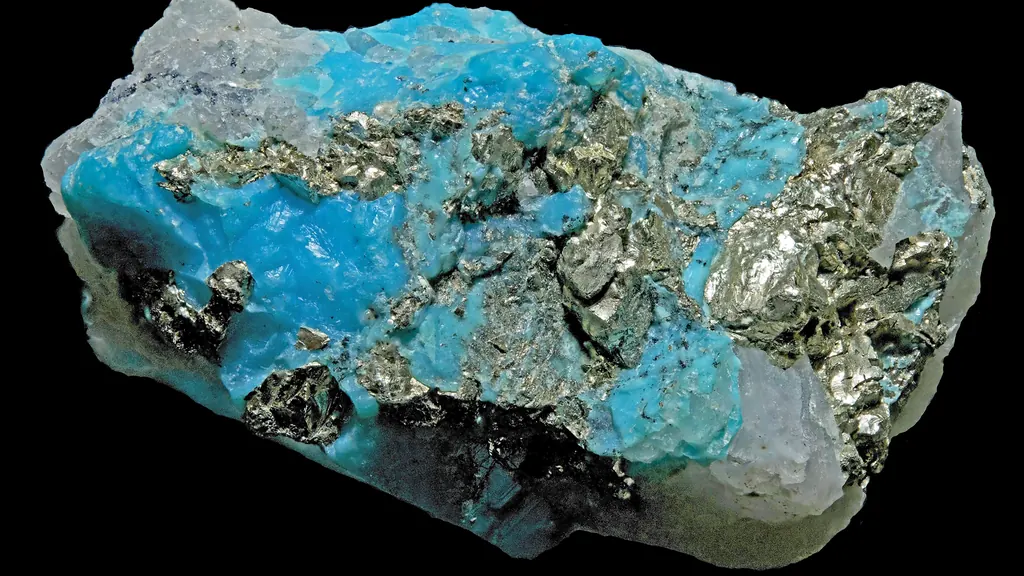
Turquoise is a soft, porous copper mineral, usually sky blue to green, often veined with brown or black host rock called matrix. Because it's porous, even real turquoise is often treated. So there are really three questions: is it turquoise at all, is it treated, and is the price fair for what it is?
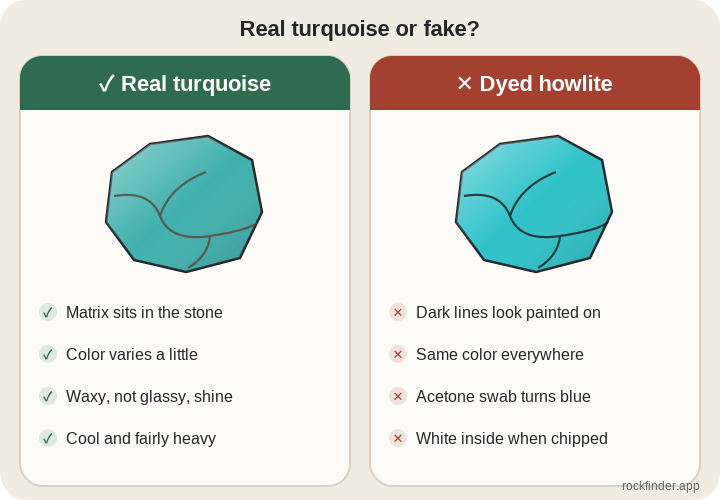
6 tests for real turquoise
1. Look at the matrix
In real turquoise, the brown, black or golden veins are part of the stone and sit level with the surface. In dyed howlite and magnesite, the grey veins often look like dark lines drawn on top, sit slightly lower than the surface, and the blue may stop sharply at their edges.
2. Look at the color
Natural turquoise varies: patches of slightly different blue or green, especially across a strand of beads. A whole necklace of identical, bright, flat blue beads is a warning sign. Check drill holes and chips too: if the inside is white, the color is only dye.
3. The acetone swab
Dip a cotton bud in acetone nail polish remover and rub a hidden spot, such as the back or inside a drill hole, for about 10 seconds. Blue on the cotton means dye. Do it in a ventilated room, and be aware that acetone can dull the polish on resin-stabilized stones, so keep to an unseen spot.
4. The shine test
Real turquoise has a soft, waxy or satin shine. Very glassy, shiny beads are often glass or heavily resin-coated. Plastic looks slightly "too smooth", and mold seams sometimes show around the edge.
5. The touch and weight test
Real turquoise feels cool and has some weight (specific gravity about 2.6 to 2.9). Plastic and resin fakes feel light and warm, and clink dully against each other. A plastic strand often feels surprisingly light in your hand.
6. The price test
Natural, untreated turquoise from known mines is expensive. A long strand of perfect blue "turquoise" beads for a few dollars is almost certainly dyed howlite or magnesite. If a seller won't say whether the stone is natural, stabilized or reconstituted, assume it's the cheapest option.
Real, treated or fake?
| Label | What it means | Value |
|---|---|---|
| Natural | Only cut and polished | Highest |
| Stabilized | Real turquoise hardened with clear resin | Medium; very common, fine if sold honestly |
| Enhanced / color-shocked | Stabilized plus dyed or treated to deepen color | Lower |
| Reconstituted | Turquoise powder pressed with resin | Low |
| Imitation | Dyed howlite, magnesite, plastic, glass | Very low: not turquoise |
Hardness tests aren't useful here: turquoise is fairly soft (5 to 6), close to its fakes, and scratching damages it.
Turquoise look-alikes that aren't fakes
Some real, natural stones simply resemble turquoise: chrysocolla (brighter blue-green, softer), variscite (green), amazonite (a feldspar with white streaks and flat cleavage), and azurite mixed with malachite. They're lovely stones; they just aren't turquoise.
Where real turquoise comes from
Turquoise forms in dry regions where water seeps through copper-bearing rocks and deposits copper aluminum phosphate in cracks. Major sources are the southwestern US (Arizona's Sleeping Beauty, Kingman and Morenci mines, and Nevada's many small mines), Iran (Nishapur, the classic "Persian" blue), China (Hubei), Egypt's Sinai, Mexico and Tibet. Experienced buyers can often guess the mine from the color and matrix, but only a lab can prove it.
What turquoise should cost
Price is a useful warning sign. Natural, untreated, high-grade turquoise from a named mine is expensive, often tens to hundreds of dollars per carat for top pieces. Stabilized turquoise is much cheaper, and reconstituted, dyed howlite or plastic is cheaper still. If a large, perfect, bright blue necklace is sold as "natural turquoise" for a few dollars, it almost certainly isn't. Ask the seller in writing whether the stone is natural, stabilized, enhanced, reconstituted or imitation. Honest sellers will tell you.
Caring for turquoise
- Turquoise is porous and soft (5 to 6), so keep it away from oils, lotions, perfume and hairspray.
- Clean it with a soft, dry or slightly damp cloth only. No soaking, ultrasonic cleaners or steam.
- Over years, natural turquoise can darken or turn greener from skin oils. Many collectors like this patina.
Still not sure?
Take a photo with RockFinder. It will tell you whether your blue stone looks like turquoise, howlite, chrysocolla or something else, and how to check it.
Questions people ask
How can you tell if turquoise is real?
Look at the dark veins (matrix): in real turquoise they sit level with the surface and look natural. Rub a hidden spot with acetone on a cotton bud: if the cotton turns blue, it's dyed. Real turquoise also has a waxy shine and slightly uneven color, and it feels cool, not warm like plastic.
What is fake turquoise made of?
Usually dyed howlite or dyed magnesite, both white stones with grey or black veins that soak up blue dye. Other fakes are plastic, resin, glass, and 'reconstituted' turquoise made from turquoise powder pressed with resin.
Is stabilized turquoise real?
Yes. Stabilized turquoise is real turquoise that was soaked in clear resin to make it harder and stop it changing color. Most turquoise in jewelry today is stabilized. It's worth less than natural, untreated turquoise, and it should be sold as stabilized.
Does real turquoise change color?
Natural, untreated turquoise can slowly turn greener over years as it absorbs skin oils, lotion and sweat. Dyed fakes may fade or rub off instead. Stabilized turquoise keeps its color best.
Keep reading
Real or fake? How to tell if your crystals are real
7 safe home tests to spot glass, dyed and plastic fakes, plus a guide for every popular stone.
Azurite: the bluest stone in nature
The blue that painted Renaissance skies, and slowly turns into green malachite.
Malachite: green stripes from copper mines
Swirling green bands born in copper mines, and a favorite of tsars and pharaohs.