
Fake malachite: how to tell if yours is real
Malachite's green bands are easy to print or mold, so plastic and resin copies are everywhere, especially in beads and carvings. Real malachite is surprisingly heavy, and that's the first clue.
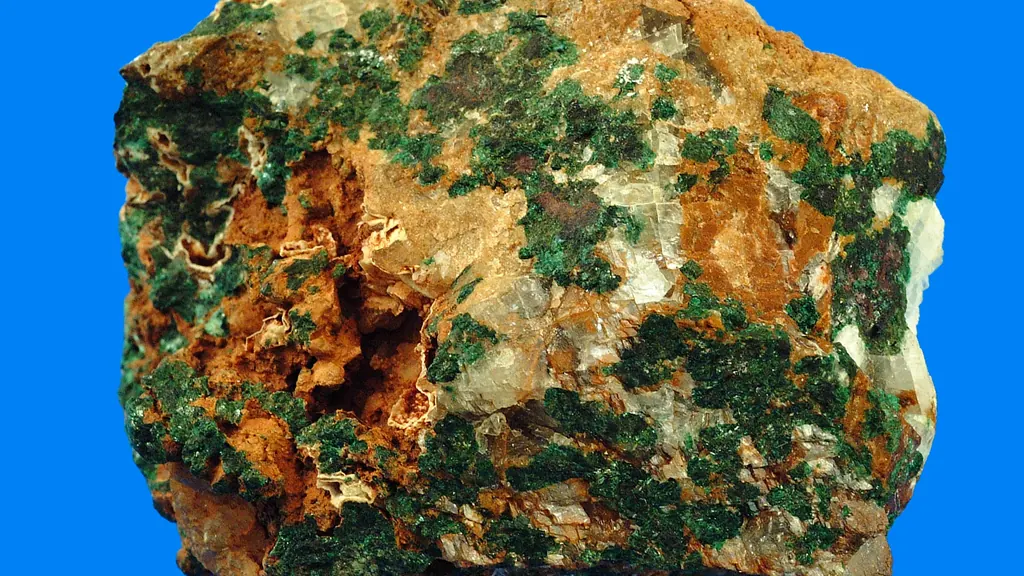
Malachite is a copper mineral, which makes it dense and gives it that deep green. Its bands form in layers, like tree rings, as it slowly grows. Copies can mimic the color, but they rarely get the weight and the natural chaos of the bands right.
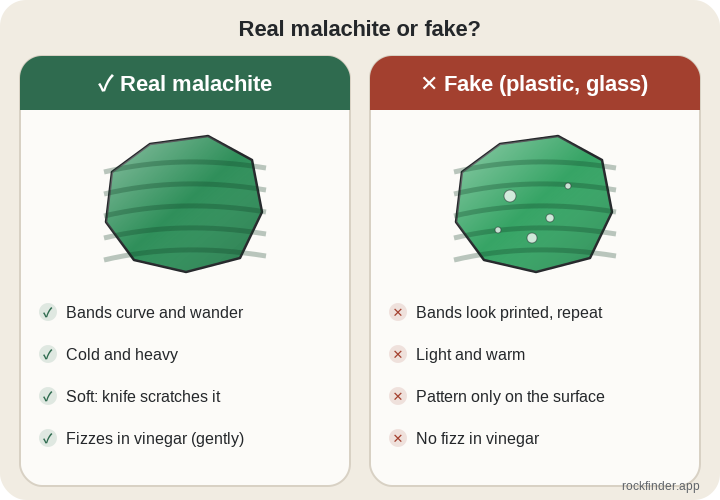
5 safe tests
1. The weight test
Real malachite has a specific gravity of about 3.6 to 4.0, so even a small piece feels heavy in your palm. Plastic and resin (about 1.2) feel surprisingly light. Our specific gravity calculator gives you a real number with a kitchen scale.
2. The band test
Look closely at the pattern. Real bands curve, split and change thickness, with light and dark greens mixed in, plus "eyes" and circles. Fakes often have evenly spaced, repeating stripes, or the same pattern on every bead in a strand.
3. The touch test
Real malachite feels cold and stays cool for a while. Plastic feels close to room temperature almost straight away.
4. The surface and edge test
Look at the drill holes on beads and any chips. In real stone, the bands run all the way through. If the green looks like a thin layer over a different color, or the inside is plain, it's printed or coated.
5. The price test
Malachite isn't rare, but good solid pieces aren't throwaway cheap either. A big, perfectly patterned carving for a few dollars is very likely resin or reconstituted.
What fake malachite usually is
| Type | What it is | Giveaway |
|---|---|---|
| Plastic or resin | Molded or printed | Light, warm, repeating stripes |
| Glass | Green glass with swirls | Shiny, bubbles, too regular |
| Reconstituted | Malachite powder plus resin | Lighter than solid, blurry bands |
| Dyed stone | Banded stone dyed green | Color collects in cracks |
Don't do these tests on malachite
Malachite is soft (hardness 3.5 to 4), so don't scratch it, and it reacts with acid, so skip vinegar or lemon tests. You'll damage a real stone.
Still not sure?
Read our full malachite guide, or snap a photo with RockFinder to check what your green stone looks like.
Questions people ask
How can you tell if malachite is real?
Feel the weight first: real malachite is about four times as heavy as water and feels dense, while plastic and resin feel light. Then look at the bands: real ones curve and vary, with circles and eyes, while fakes often repeat. Real malachite also feels cold to the touch.
Is reconstituted malachite real?
Reconstituted malachite is made from real malachite powder or chips mixed with resin and pressed into blocks. It contains some real malachite but is worth much less than solid stone. It often feels lighter and the bands can look blurry or chunky.
Can malachite get wet?
Briefly, yes, but it's soft and reacts with acids, so don't soak it, clean it with vinegar or lemon, or use harsh cleaners. Wipe it with a damp cloth and dry it.
Is malachite safe to handle?
Polished malachite is fine to handle. Don't sand, cut or grind it without a mask, because the dust contains copper and shouldn't be breathed in or swallowed.
Keep reading
Malachite: green stripes from copper mines
Swirling green bands born in copper mines, and a favorite of tsars and pharaohs.
Real or fake? How to tell if your crystals are real
7 safe home tests to spot glass, dyed and plastic fakes, plus a guide for every popular stone.
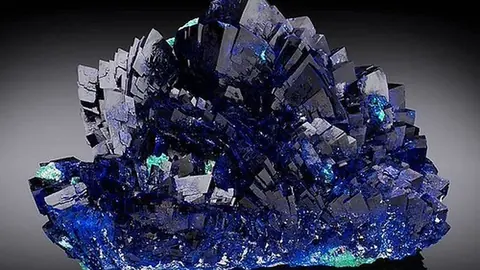
Azurite: the bluest stone in nature
The blue that painted Renaissance skies, and slowly turns into green malachite.