
Concretions: the weird round rocks everyone thinks are eggs
They look like cannonballs, dinosaur eggs, turtles or even petrified hamburgers. Concretions are among the most-reported 'mystery rocks' on Earth.
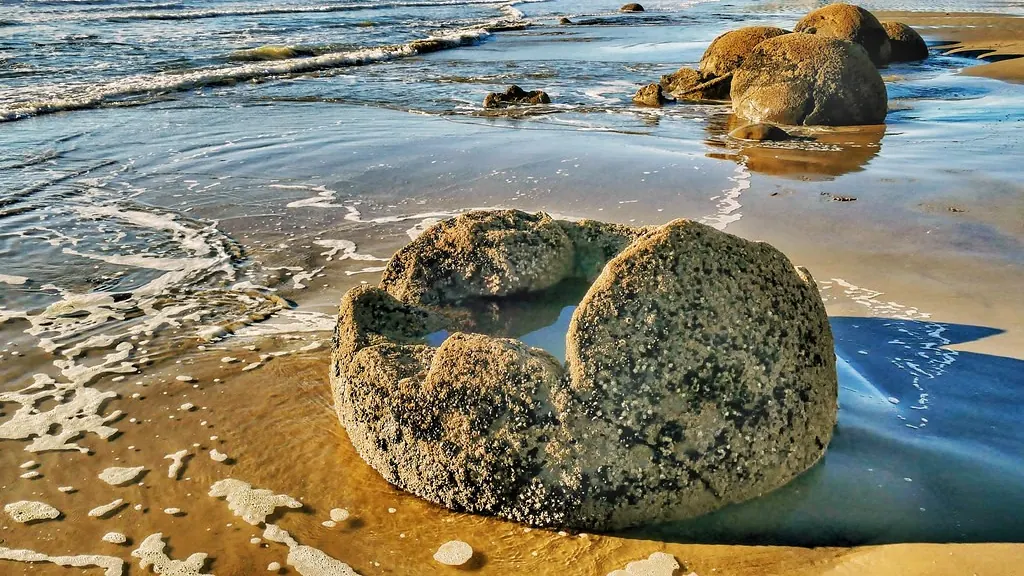
Every museum and geology department gets the same email over and over: "I found a dinosaur egg!" Attached is a photo of a smooth, round, egg-shaped rock. And almost every time, the answer is the same: it's a concretion.
Don't be disappointed. Concretions are genuinely strange and often hide something amazing inside.
How concretions form
Imagine soft mud or sand on an ancient sea floor. Something small, like a shell, a leaf or a dead fish, starts to decay, changing the chemistry of the water around it. Minerals like calcite, iron oxides or silica begin to crystallize around that center, cementing the sediment into a hard ball. It grows outward, layer by layer, sometimes for thousands of years.
Millions of years later, the softer rock around it wears away, and the hard concretion pops out, perfectly round and looking completely out of place.
How to identify a concretion
- Rounded shape: spheres, eggs, discs, or fused clumps like bunches of grapes
- Same material as the surrounding rock, just harder
- Found in or near sedimentary rock: shale, sandstone, clay
- Layers like an onion when broken, or solid all the way through
- Sometimes a fossil or crystal-lined center
Concretion vs dinosaur egg
| Concretion | Dinosaur egg | |
|---|---|---|
| Inside | Solid rock, or onion layers | Filled with sediment inside a distinct shell |
| Surface | Smooth or rough rock | Thin shell, often bumpy, with tiny pores |
| How common | Very common worldwide | Rare, in a few specific rock layers |
The world's most famous concretions
- Moeraki Boulders, New Zealand: giant spheres up to about 2 meters across, scattered on a beach like marbles
- Bowling Ball Beach, California: rows of perfectly round boulders
- Mazon Creek, Illinois: small concretions that split open to reveal 300-million-year-old ferns, jellyfish and the bizarre "Tully monster"
- Mars "blueberries": NASA's Opportunity rover found tiny hematite concretions on Mars in 2004, a clue that water once flowed there
Septarian nodules: concretions with cracks
Some concretions shrank and cracked inside, and the cracks filled with yellow calcite. Cut and polished, these septarian nodules show a beautiful web of yellow veins on grey. They're sold as "dragon stones" and make great bookends.
What are concretions worth?
| Item | Rough value |
|---|---|
| Ordinary concretions | Usually nothing, but great conversation pieces |
| Unusual shapes ("figure stones") | About $10 to $100 |
| Polished septarian nodule halves | About $10 to $100+, depending on size |
| Mazon Creek fossil concretions | About $10 to hundreds of dollars for rare species |
| Ammonite-bearing concretions | About $20 to thousands of dollars |
Prices are rough guides. Concretions at protected sites like the Moeraki Boulders must be left in place.
Round mystery rock?
Snap a photo with RockFinder to see if it's a concretion, a fossil or something else.
Questions people ask
What is a concretion?
A concretion is a hard, compact mass of mineral cement that formed inside sediment, usually around a small center like a shell, leaf or grain. Over time it hardens more than the surrounding rock, and when that rock erodes away, the round concretion is left behind.
Is my round rock a dinosaur egg?
Almost certainly not. Real dinosaur eggs are rare, have a thin shell with a bumpy texture and a visible pore structure, and are found in specific places. Concretions are solid all the way through, often with layers like an onion, and are very common.
Do concretions have fossils inside?
Sometimes. Many concretions formed around a dead plant or animal, and splitting them can reveal beautiful fossils, like the Mazon Creek ferns and creatures in Illinois or ammonites in England.
Are concretions worth money?
Most are worth little, but some are prized: septarian nodules are polished and sold for decor, fossil-bearing concretions can be valuable, and unusual shapes sell to collectors for tens to hundreds of dollars.
Keep reading
Shale: the crumbly rock that holds Earth's best-kept secrets
The world's most boring-looking rock is a fossil vault. Here's how to open it.
Dinosaur bone: how to tell if you've found a piece of a dinosaur
Kids and hikers find real dinosaur bones. Here's how to recognize one.
Types of rocks: the 3 kinds, and how to tell which one you're holding
Fire, layers or pressure? Every rock you find is one of three types.